Free shipping across India over ₹699 · 10% off your first order with code AORA10Shop the catalog →
Gut Health Supplements: What to Look For on a Label A draft brief for commercial investigation around "gut health supplements", pending human writing, citation verification, and editorial review.
10 linked sources checked against our citation and claim-safety process.
Updated 11 Jun 2026 with supplement-claim and medical-disclaimer boundaries.
This commercial is written for readers comparing gut health supplements in the context of Gut & Digestion, not for generic supplement browsing.
Use it to shortlist what to check on a label, what to ask before buying, and when a product is not the right next step.
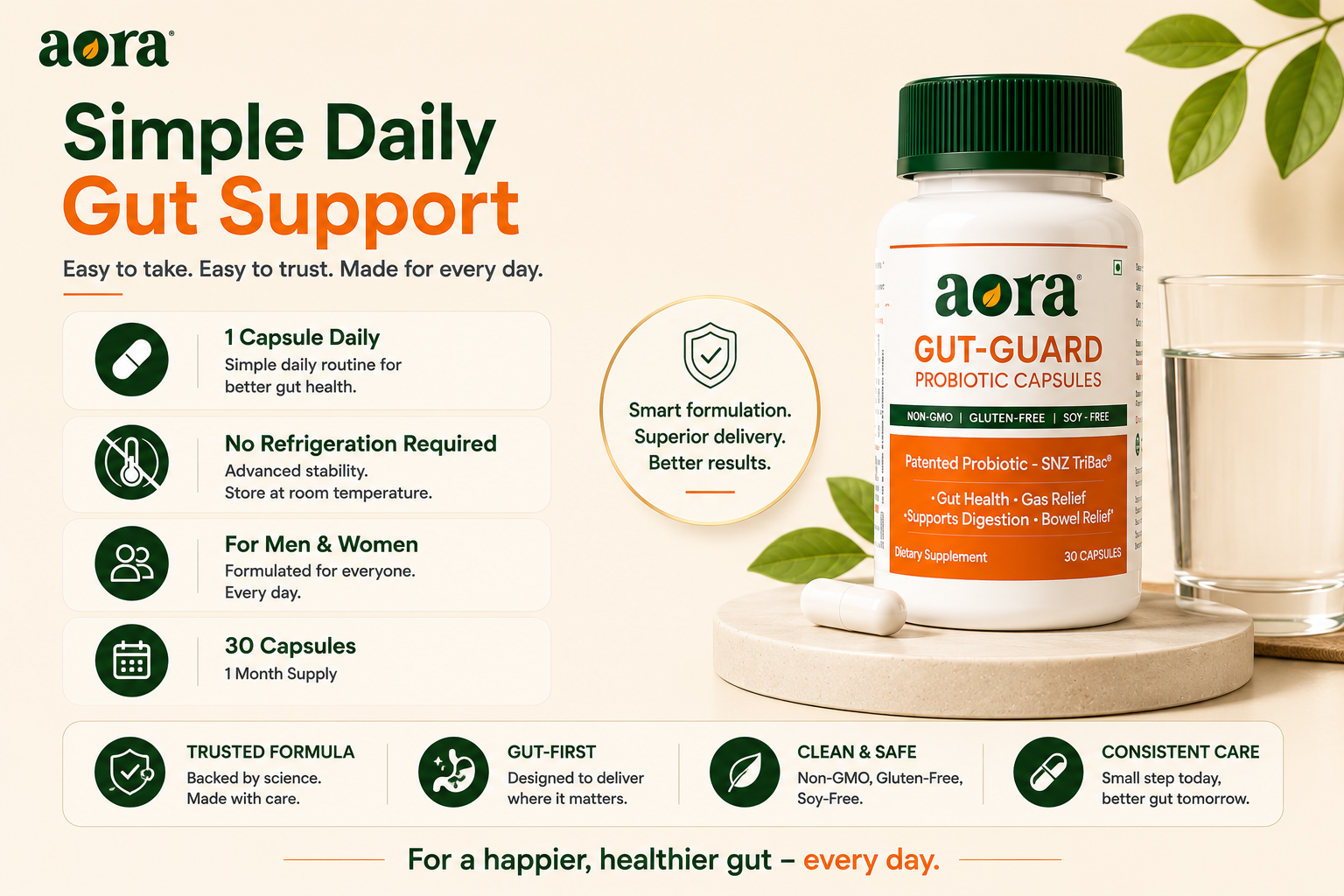
Aora connects the topic to Aora Gut Guard, probiotic routines, digestive enzymes only where the article gives enough context to keep the claim responsible.
We avoid disease-treatment promises, detox shortcuts, guaranteed outcomes, and dosage advice that should come from a qualified clinician.
A good label makes your decision easier. It does not hide behind big numbers and vague blends. Whether you are comparing gut health supplements — probiotics, prebiotics, digestive enzymes, or combination formulas — one rule holds: clarity beats hype. This checklist covers what to read on the pack before you buy, and which marketing promises should send the bottle back to the shelf.
Look for:
The NIH Office of Dietary Supplements explains that a probiotic is identified by its full strain — the genus, the species, and an alphanumeric strain designation — and that a product's benefits, if any, depend more on the specific microorganisms it contains than on the number of colony-forming units (CFUs) (NIH ODS). That is why "50 billion CFU" alone is not a quality signal: the number means little without a named, studied strain behind it.
CFU counts also fall over time. ODS notes that the number of CFUs can decline before you use the product, so some experts recommend choosing products that list the CFUs guaranteed *through the expiration or use-by date* rather than at the time of manufacture (NIH ODS Consumer). Favour that transparency over a big headline number.
If you are still deciding whether a probiotic is even what you need, our guide on Probiotics vs Prebiotics: What Is the Difference? breaks down which one does what.
Look for the **source and amount**. Inulin, fructooligosaccharides (FOS), resistant starch, and other fibres can feed beneficial bacteria, but the dose matters: too much too fast can cause gas or bloating. The National Institute of Diabetes and Digestive and Kidney Diseases (NIDDK) explains that gas normally forms when bacteria in the large intestine break down certain undigested carbohydrates (NIDDK). A label that names the fibre type and grams per serving lets you start low and build up — something a vague "proprietary prebiotic blend" cannot.
Look for **named enzymes and their activity units**, not a generic "enzyme blend." Be cautious with products that imply they treat serious digestive disease. NIDDK describes exocrine pancreatic insufficiency (EPI) — when the small intestine cannot fully digest food because of problems with pancreatic enzymes — as a medical condition that requires diagnosis and is treated with prescription pancreatic enzyme replacement therapy, not an over-the-counter supplement (NIDDK). If occasional bloating is your concern, our explainer on Digestive Enzymes Explained: Who Needs Them and Who Does Not covers when they genuinely help.
Be sceptical of labels or ads that promise:
In India these are not just marketing red flags but potential regulatory violations. Under the Food Safety and Standards (Health Supplements, Nutraceuticals…) Regulations, 2022, a supplement label may not claim to treat, cure, mitigate, or prevent any disease, and most health supplements must carry the statement **"NOT FOR MEDICINAL USE"** (FSSAI). A brand that ignores those rules is telling you how carefully it follows the others.
Probiotics have a long history of apparently safe use in healthy people. Still, the NIH's National Center for Complementary and Integrative Health (NCCIH) cautions that the risk of harmful effects is greater in people with severe illness or weakened immune systems, and that benefits seen with one strain do not automatically apply to another (NCCIH). **Talk to a doctor or registered dietitian before starting a supplement** if you are pregnant, immunocompromised, managing a chronic gut condition, or giving a product to a child — and if symptoms persist despite a sensible routine, get them properly checked rather than self-treating.
The best gut health supplements are the boring-looking ones: a named strain, an honest CFU promise, a clear fibre dose, and no disease-cure language. A supplement belongs *beside* a food-first approach — plenty of fibre, fermented foods, and variety — not in place of it. Benefits also build gradually; for a realistic timeline, see How Long Do Probiotics Take to Work?.
Start with meal timing, stool pattern, trigger foods, hydration, and whether symptoms are new or recurring. Those details usually change the answer more than the brand name.
No. Food, sleep, movement, hydration, testing, or a clinician conversation may be the better first step. A supplement makes sense only when the label fits a clear routine job.
Look for the ingredient form, amount per serving, serving instructions, warnings, overlap with other products, expiry, and whether the claim stays within responsible wellness language.
Ask before changing supplements if symptoms are severe, new, persistent, linked to abnormal labs, affected by medicines, or connected to pregnancy, breastfeeding, kidney, liver, heart, hormone, or mental-health concerns.
Connected guides, ingredient explainers, product context, and tools chosen from this article's topic cluster.
Bloating, acidity, probiotics, enzymes, microbiome basics
Probiotics are live microorganisms that can confer a health benefit when used in adequate amounts. Results are strain-specific, reason-specific, and not guaranteed for every gut complaint.
Prebiotics are substrates used by beneficial microbes. In plain language, many are fibres that feed gut bacteria. They can be useful, but starting too fast can worsen gas and bloating.
Relevant for probiotic and gut-comfort routines.
gut health after travel: a practical Aora guide to evidence, label checks, safety cautions, and when supplements make sense.
protein powder and digestion: a practical Aora guide to evidence, label checks, safety cautions, and when supplements make sense.
gut health and bad breath: a practical Aora guide to evidence, label checks, safety cautions, and when supplements make sense.
Start with meal timing, stool pattern, trigger foods, hydration, and whether symptoms are new or recurring. Those details usually change the answer more than the brand name.
No. Food, sleep, movement, hydration, testing, or a clinician conversation may be the better first step. A supplement makes sense only when the label fits a clear routine job.
Look for the ingredient form, amount per serving, serving instructions, warnings, overlap with other products, expiry, and whether the claim stays within responsible wellness language.
Ask before changing supplements if symptoms are severe, new, persistent, linked to abnormal labs, affected by medicines, or connected to pregnancy, breastfeeding, kidney, liver, heart, hormone, or mental-health concerns.
Supplement content is educational only and should not replace medical advice from a qualified clinician. Product mentions are reviewed for claim safety before publication.